Posts

Oolongs

Image
I had a surprise in my last tea order. I ordered 2 oolong teas, and when I opened the packages, they looked the same. I mean, they looked EXACTLY the same. Did they make a mistake and fill both of my bags with the same tea? I've had the Wuyi Shan Ti Kwan Yin before. I know what it is supposed to look like and smell like. That bag checks out. It's the correct tea.  Wuyi Shan Ti Kwan Yin This oolong has kind of a fruity type scent and flavor. So I turned my attention to the milk oolong. I gave it a sniff. It smells different. It doesn't have the fruity notes in it. I brewed a cup, and it has a sweet, mellow flavor. Interesting, what is the difference? Milk oolong The description of milk oolong states that this is a semi-oxidized tea made from the leaves of tea plants growing between 1600 and 4000 feet above sea level. The plucking can only occur on mornings following a precipitous drop in temperature in comparison to the day before (this immediately reminds me of maple syrup ...
Ecuador

Image
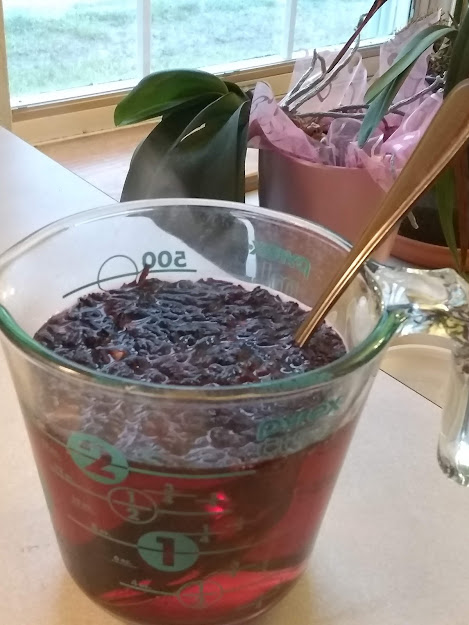
 Today we travel to Ecuador with a beautiful, red tea. Ecuador sits on the Pacific Ocean between Peru and Colombia. They have a long history with science, and the country is described as being one of the most environmentally diverse in the world. Some of the notable science/scientists who worked there were Charles-Marie de La Condamine (first scientific expedition to measure the circumference of the Earth), Alexander von Humboldt, and Charles Darwin also worked there studying geography, ecology, and evolutionary biology. I was also surprised, but not surprised, to learn that the country was named for the Equator, which runs through the top portion of the country. The land was also part of the Inca empire in pre-Columbian times. Notably, the Galapagos Islands are part of their territory.  I thought it was funny that were a major exporter of Panama hats in the mid 18th century to people looking for gold, and the early 19th century for the builders of the Panama canal. Those Pan...

Qigong tea

Image
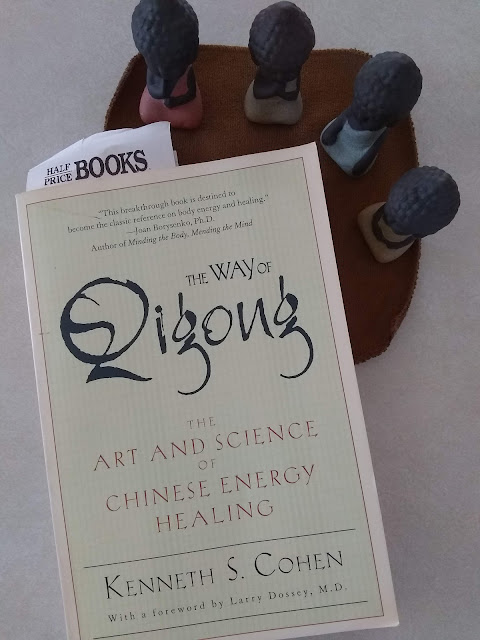
Thanks to the pandemic, I've finally invested the time to learn the Yang 24 form of tai chi from a DVD I bought several years ago. Actually, I learned it through the combination of the DVD and a book. I've also been reading this book on qigong off and on for the past year. Thank you Half Price Books for making the used paperback version even cheaper than the Kindle version.  While tai chi and qigong are different, they do share some of the same concepts. I find that the concentration required for tai chi helps decrease anxiety, and the exercise is gentle and helps improve my posture. I can't say that I have done a lot with qigong yet, but while flipping through the book recently, I discovered that there is an ENTIRE chapter on tea. Of course you knew that I had to try it out. It was also the perfect excuse to buy yet another tea set. I had been contemplating buying this style of tea set for my birthday, and I finally found the style of set at a price point I was willin...

Dragon's Well versus Snow Dragon

Image
 Today's post is another comparison of teas. In my last tea order, I got a bag of snow dragon green tea. This tea is described as being from Fujian province in China. The liquor is described as being earthy in aroma, and mellow in taste. When I got the tea, it really reminded me of dragon's well in look. It also appears to be a pan fired tea. According to the Tao of Tea website, a single bud and leaf are plucked, then gently pan roasted over low heat. The leaf is said to be dragon shaped, and the white down is carefully preserved during processing to lend the "snow" part of the name.  Dragon's well (aka lung ching) is noted for 4 unique characteristics: jade color, vegetative aroma, mellow chestnut flavor, and its broadsword shape. It is collected just after the rains in the tea fields surrounding the famous Dragon's Well in the hills near West lake. It took me a bit longer to find West Lake China. It turns out that it is in Zhejiang province which is just nor...

The simple pleasures in life

Image
 This morning I realized that I was out of finished posts (I have several that are partially written), and right now I don't feel like hurriedly finishing any of the ones I started. Thanks to a cold front (sadly with no appreciable rain), it is actually comfortable outside. Since it has been dry, dry, dry around here, I can open my windows without my asthma going crazy (although I had to close my windows last night because surprise surprise someone decided to have a fire). Thankfully nothing in the neighborhood is burning right now, so I opened the windows and enjoyed some pu-ehr. 

Kava tea

Image
 When I looked at Oceana countries, I found another tea that is illegal in parts of the world. One article says that it is illegal in Europe and Canada, while it is not illegal in the states. All of the "kava" I've seen are really just a blend of herbs, and I don't think any real kava root is involved. Why? From my research, kava root is described as being a mild narcotic, or having similar effects as alcohol. It has also been linked to liver damage and death. I'm so not pursuing this tea to try. There were 3 countries where I only found references to Kava tea.  Samoa  is in the central south Pacific on the western edge of Polynesia. It is sometimes referred to as the cradle of Polynesia, and is believed to be where Polynesian culture developed. They gained their independence from New Zealand in 1962, but is still part of the commonwealth. Samoa is classified as a micronation. Their land consists of 9 islands, 4 of which are inhabited, and 5 that are not. Their to...

A tea I will never try

Image
Exploring South America has yielded a surprise. A type of tea that I will never try. Why won't I try it? Well, obtaining the ingredients to make it would be illegal, at least where I live. I found some countries that made tea from dried cocoa leaves. One of the videos did address that this tea does contain a very small amount of cocaine. They said it wasn't enough to get high off the tea, but it would trigger a positive drug test. The interesting thing is when I googled cacao leaves to find a picture (I don't even know what cocoa leaves or plants look like), I found advertisements to buy cacao leaves, even cacao leaf tea on Amazon. I was suspicious. After all, there is another type of tea called kava that is made from a root that makes a mildly narcotic brew. While there are many teas in the states that are labeled "kava" tea, they don't contain any of that root, and it is apparently a fashionable name applied to teas that are a jumble of herbs mixed togethe...